
In this blog series, we continue our series on new analytical and reporting capabilities in Syndeia 3.6 for the Syndeia Web Dashboard. Graph analysis has been a key piece of Syndeia for several years. Users could enter queries for their digital thread and get real-time answers about relationships between model elements, even when the project scope encompassed millions of data points. These could be frequently asked questions (FAQs) that could be run each day for project management, project meetings or design reviews. But in previous releases of Syndeia, these queries could not be conveniently stored or distributed.

Query libraries, new in Syndeia 3.6, provide a powerful capability for project leads to develop collections of digital thread queries that can be executed on demand or automatically via the API. Query authors familiar with the Gremlin graph query language can develop, test, validate and save collections of project-specific Gremlin graph queries that can be run by all participants on the Digital Thread Project. Users without that graph query expertise can run a single query or an entire collection and visualize results in the dashboard. Feature-rich controls for managing queries and visualization of results are available on the dashboard.

Query libraries are accessible from the Explore > Queries tab of the Digital Thread Project Dashboard, as shown in Figure 1. This page includes capabilities for the query author to enter, test, edit, clone and store queries and capabilities for the query users to run and download results in graphical, tabular and JSON format. Syndeia 3.6 has also added extensive graphical controls to modify the visual appearance of the results.
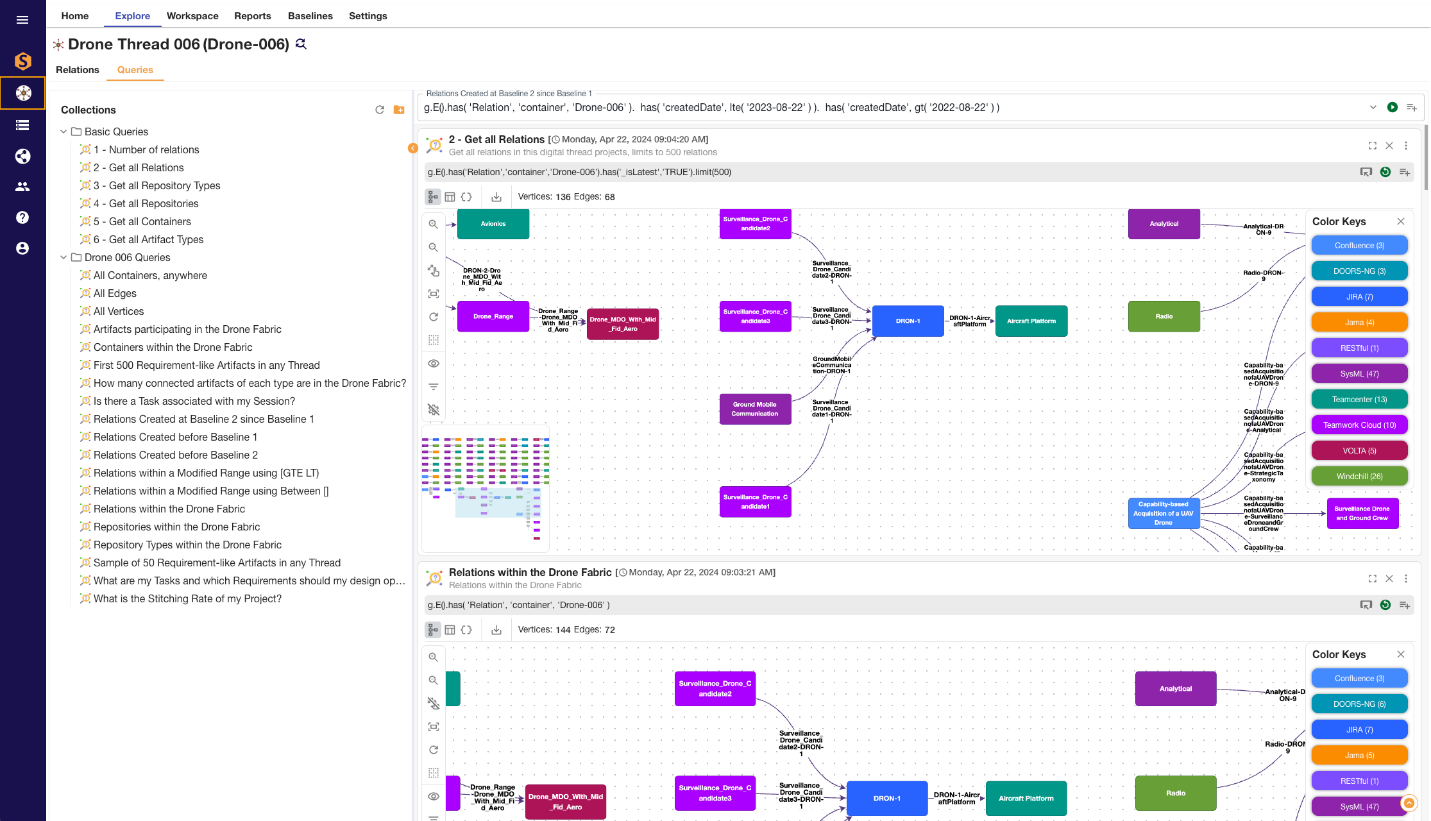
Syndeia Web Browser, DTP Dashboard, Explore tab, Queries subtab

Figure
1  Syndeia Web Browser, DTP Dashboard, Explore tab, Queries subtab

The Graph Queries page, launched from the icon in the main control bar, is still available in Syndeia 3.6 and has enhanced graphical control settings.

In the forthcoming Part 7, we will discuss the new Baselines feature in Syndeia 3.6, taking advantage of the configuration-managed Syndeia inter-model relations database to track changes in the digital thread over time.

Other parts in this series:

  • Syndeia 3.6 Release, Part 6: Digital Thread Project Graph Query Libraries (This Post)

Related Posts

Pipelines Part 4 - UAF Mission Architecture to Confluence Reports — Automatically

Systems engineers invest enormous effort building architecture models. A well-constructed UAF model captures mission capabilities, operational activities, services, resources, and ...
Manas Bajaj

Pipelines Part 3 – Matching Requirements to Parts using Syndeia Digital Pipelines

We’re continuing our blog series on using Syndeia digital pipelines to execute real world use cases in systems engineering. In Part 2, we demonstrated a digital pipeline that ...
Dirk Zwemer and Gregory Seeds

Pipelines Part 2 – Gap Analysis between Requirements and Tests

Demonstrating measurable ROI from digital engineering is just as important in driving enterprise adoption as customer mandates, e.g. DoDI 5000.97. In particular, the concept of ...
Dirk Zwemer and Gregory Seeds

Pipelines Part 1: Quick Introduction and Demo

Syndeia Pipelines automate digital engineering workflows by orchestrating complex, multi-step tasks, such as ETL operations, cross-repository queries, model transformations/syncs, ...
Manas Bajaj

Christmas at the North Pole, Powered by Pipelines🎄

While the rest of the world is busy hanging lights, doing last minute gift shopping, and sipping cocoa, the North Pole is deep in digital engineering mode. Snow is falling, elves ...
Manas Bajaj

What’s New in Syndeia 3.7? - Part 1

We are excited to release Syndeia 3.7, the next generation of our digital thread platform for integrated digital engineering. Check out the latest features in less than 5 minutes ...
Dirk Zwemer

Model-Based Systems Engineering for Autonomous Vehicles, Part 16 – Custom Dashboards

In Parts 1-10 of this blog series, we built a digital thread for an autonomous vehicle system to demonstrate how a federation of models in different software tools can become a ...
Dirk Zwemer

Model-Based Systems Engineering for Autonomous Vehicles, Part 15 – Digital Pipelines

In Part 14 of this series, we developed a custom script to calculate project metrics for our Autonomous Vehicle digital thread project. The value of this information is greatest ...
Dirk Zwemer

Model-Based Systems Engineering for Autonomous Vehicles, Part 14 – Open REST API

Syndeia has been developed as an API-first enterprise application, i.e. the full capabilities of the software are exposed through an open REST API with the understanding that the ...
Dirk Zwemer