
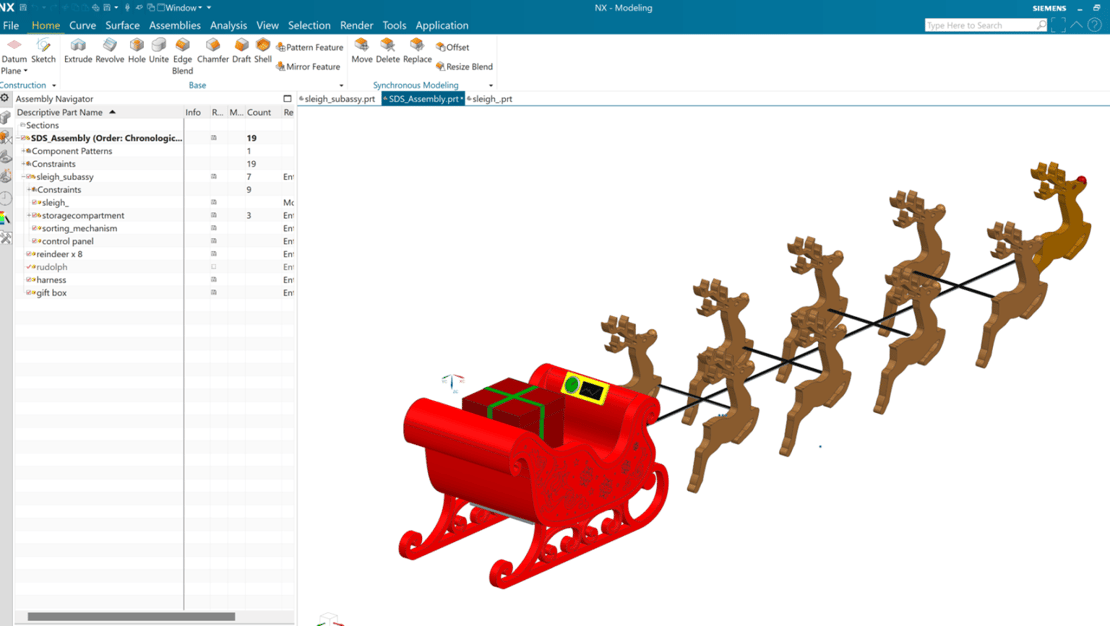
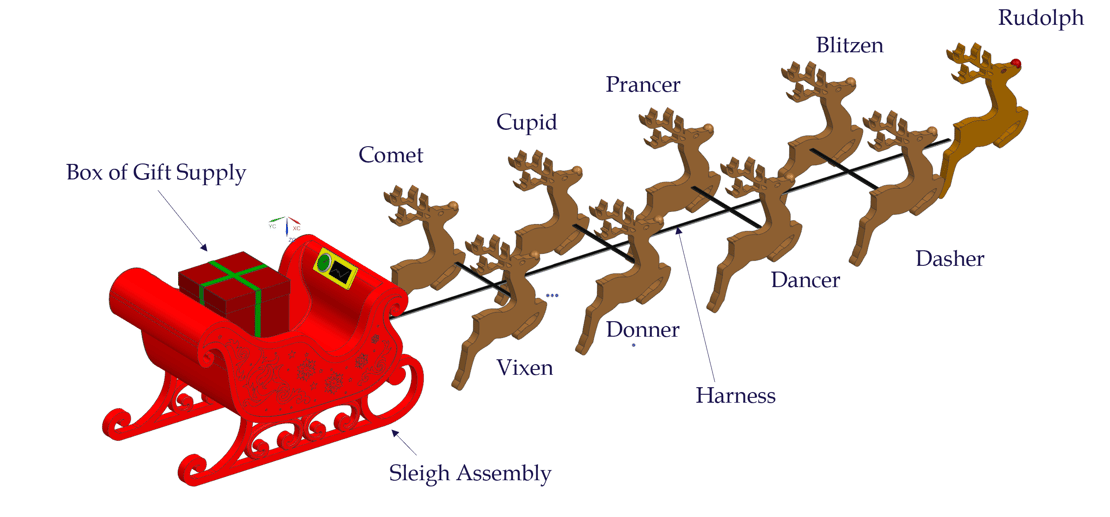
It is Day 3 and Tony Sparkgear (Chief-Hardware-Elf) had his team of elves are working hard to create a 3D model in NX parametric software to represent the Sleigh Assembly as shown below. Figure 1 shows the overall system as created in NX of the Sleigh with the infinite gift box integration to deliver joy to the entire world, and the lightspeed propulsion driven by the magical reindeer team. The gift box is essentially a portal to Santa’s workshop where trillions of finished products are ready to bring joy to the world. Figure 2 shows the clear labels of the Sleigh Delivery System components so that Chief-Architect-Elf can understand the system and most importantly account for Rudolph the team leader!
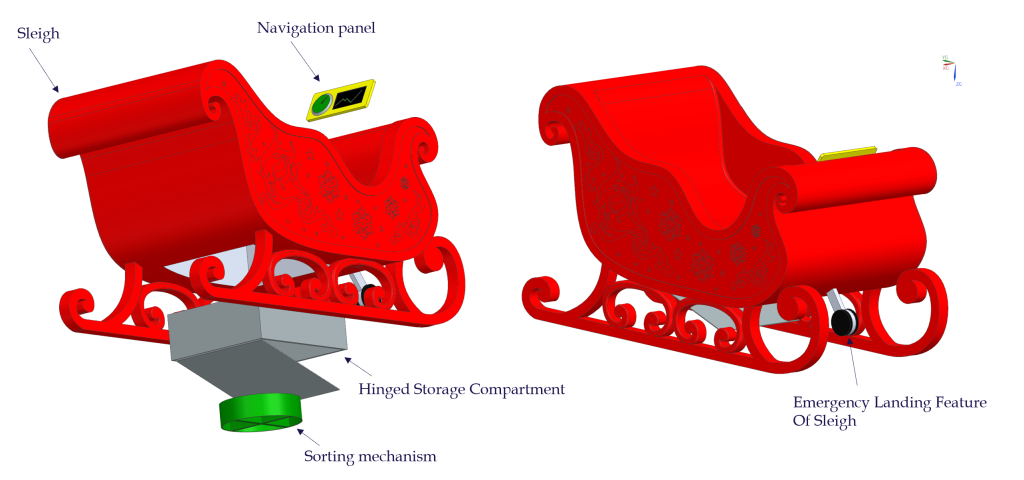
The Magical Sleigh has been fitted with a few crucial components as show below, including the Navigation panel (that also acts as the reindeer health monitor), the dynamic gift storage compartment, and the efficient gift sorting mechanism. The Navigation Panel is voice activated and only recognizes Santa’s distinct tone. The gift storage compartment dynamically fills from the North Pole via a wormhole so at a given point in time, the sleigh weight is optimized for lightening fast travel. The sleigh frame includes an adjustable emergency landing wheel so that if a blizzard knocks off one of the sleigh rails, Santa can still be able to make a soft landing.
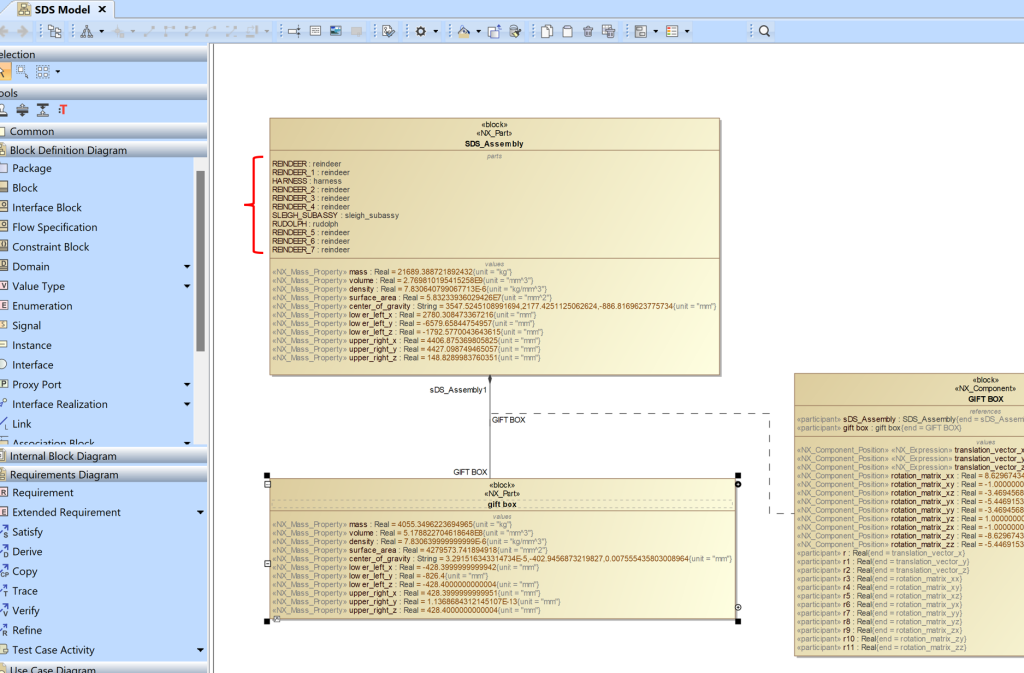
Axle Winterforge (Mechanical-Systems-Elf) is working with Bernard (Chief-Architect-Elf) on verifying SDS mass requirements in a SysML 1.6 model in Cameo. Using Syndeia, they are able to drag and drop the CAD assembly from NX into Cameo to generate a block structure with the mass properties of the SDS assembly. The NX Part stereotype of each block has automatically been applied, and the parts of the assembly have been carried over into Cameo as shown below in the ‘SDS_Assembly’ block. Furthermore, the exact mass properties of the original Sleigh Assembly CAD model have been synced over to the Cameo model! With the reinforced sleigh frame, the massive powerful 9 reindeer, and the magical gift box loaded up, we are sitting at a comfortable 21000 kg. The team is ecstatic at the model transformation and sync capabilities of the Syndeia platform.
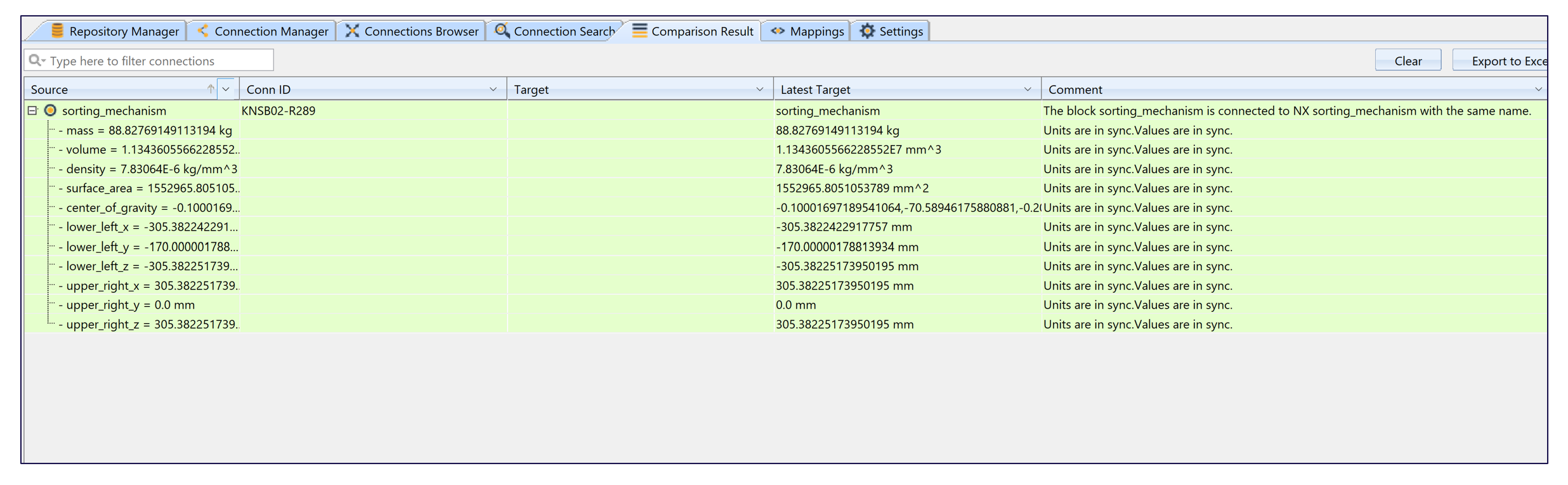
Bernard wants to keep a close watch on the mass and volume of the gift sorting mechanism to make sure it fits nicely in the storage compartment and doesn’t cause any issues for Santa. Using Syndeia, he triggers a comparison to make sure all of the value properties are matching between the NX model and the Cameo element. All is green, just like his slick green elf shoes!
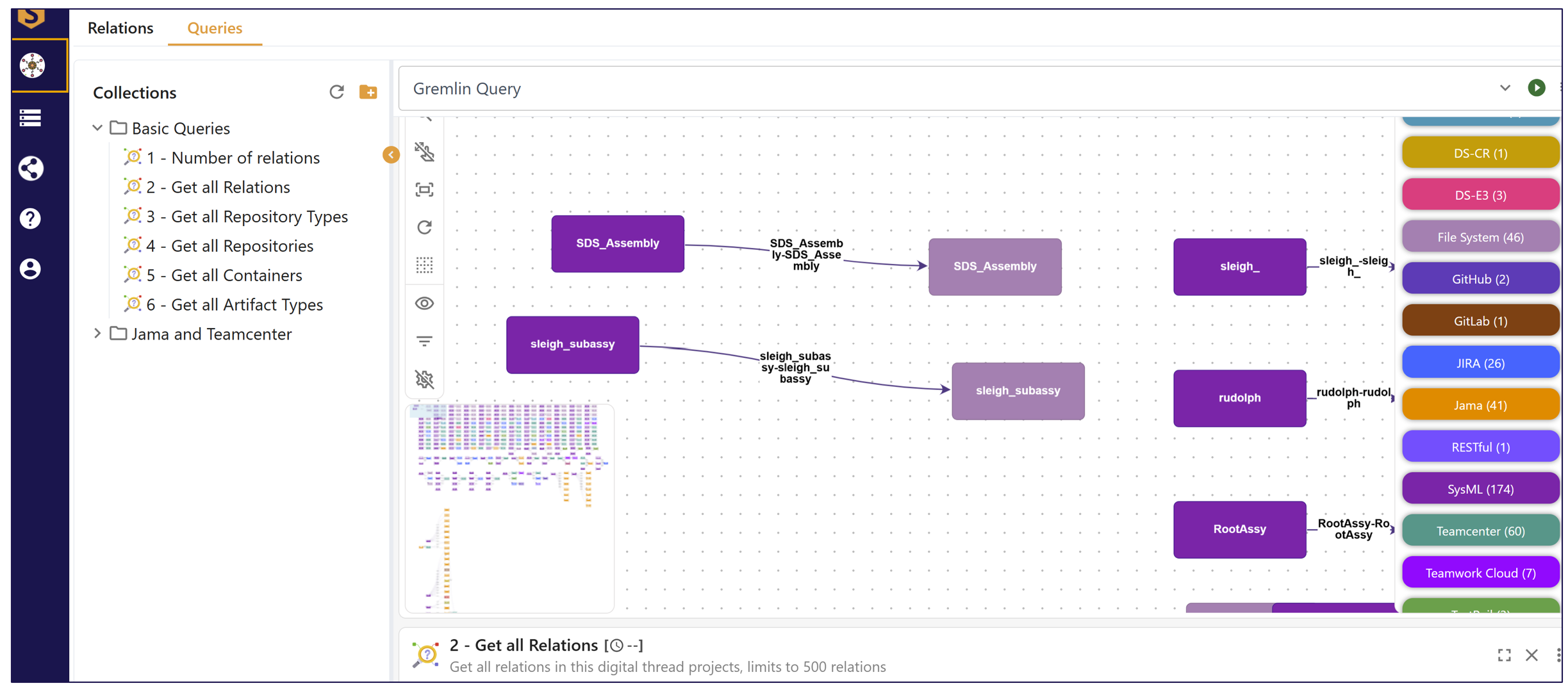
Mrs. Claus and Bernard are now able to use the Syndeia Web Dashboard to view the Digital Thread connecting the NX model to the SysML model in Cameo in real time for the SDS Assembly for impact analysis. Any change in the Sleigh design can now be traced to the SysML model! Mrs. Claus comments, “This will be our first digitally engineered Christmas operation due to Syndeia!”
Note: This post is compiled by our Mechanical CAD wiz Kenneth Naylor and posted on his behalf.
Summary of Syndeia at North Pole for Santa Mission 2024
- Day 1 – North Pole Calls Intercax for Digital Mission Possible
- Day 2 – Sleigh Delivery System – Architecture and Digital Thread Dashboard
- Day 3 – This post.
- Day 4 – SDS Hardware, Software, and Verification Digital Threads go live
- Day 5 – Santa’s Mission 2024 with 8.2 billion landings made possible by Digital Threads