
With the 3.2 release, Syndeia is now available as a standalone client. In addition to its existing plug-ins for MagicDraw and Rhapsody, Syndeia can now be used by team members without a SysML modeling tool. This is made possible by the introduction of Syndeia Cloud, a server-based repository for the for inter-model-connections. In Figure 1, we see both formats in parallel, accessing Syndeia Cloud through the same REST API.
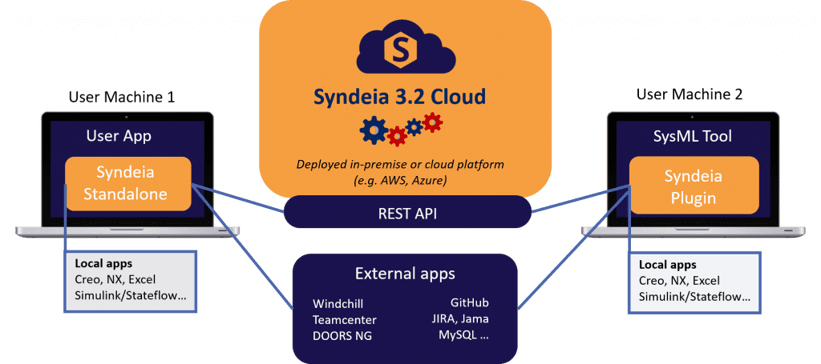
In Syndeia 3.2, its first iteration, Syndeia Standalone will be able to open a project on the Syndeia Cloud, view all inter-model connections and create, compare and sync direct reference connections between web-based repositories, such as Teamcenter, Windchill, DOORS NG, Jama, JIRA, GitHub, MySQL, and other tools if the appropriate Syndeia tool interfaces are available.
Syndeia Standalone in Action
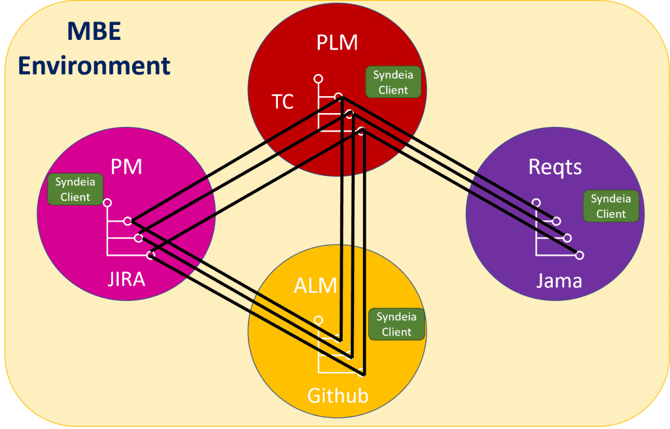
Let’s create a network using elements from an Autonomous Driving System model, with no SysML model involved. First, we will create connections from requirements in Jama to product feature captured as Teamcenter items. Each feature is connected to a software file managed in GitHub that implements that feature and to a JIRA issue that tracks progress on the implementation. Finally, we will add direct connections from GitHub to JIRA.
Watch this process in action in a short video
Ultimately, twelve connections are stored by Syndeia, three sets of Jama-Teamcenter-GitHub-JIRA connections.
Availability
The Syndeia Standalone application is available with the Syndeia 3.2 release at no additional charge to every Syndeia floating license customer with current M&S coverage. The Standalone will consume one floating license of Syndeia during use, the same as the MagicDraw or Rhapsody plug-in versions.
Syndeia Standalone uses the Syndeia Cloud, which must be installed and operating for it to work. The option to store inter-model connections in the SysML model is not available in the standalone client. Because of this, evaluation licenses of the Syndeia Standalone are only available by special consultation with Intercax. Contact us to discuss your situation.
Next Steps
Syndeia 3.2 is one step on the path to a complete MBE enterprise application. More and more Syndeia functionality will reside on Syndeia Cloud. As this transition takes place, the capabilities of the Syndeia Standalone will grow in future releases. Watch our website for more information.
The availability of Syndeia Cloud also opens up the possibility of user-written applications that use its open REST API. Watch this blog for more information.
Related Posts:
- Introduction to Syndeia 3.2 | Part 1
- Introduction to Syndeia 3.2 | Part 2
- Introduction to Syndeia 3.2 | Part 3 (this post)
- Introduction to Syndeia 3.2 | Part 4 (coming soon)
- Introduction to Syndeia 3.2 | Part 5 (coming soon)