
Efficiency in healthcare delivery has long been a target of systems engineering and operations analysis effort. Improvements in emergency room care, for example, can lead to better outcomes and better patient experience while reducing the cost of care. In this post, we apply simple parametric analysis to testing medical facility staffing and supply against requirements, all captured in a SysML model, but linked to mathematical solvers, databases and potentially other models in other tools. The top figure shows the system structure of a chemotherapy facility, a domain consisting of one-to-many drug delivery stations, nurses and patients, as well as a drug supply of several available chemotherapy drugs. The architectural elements are shown in gray. The green blocks represent analysis models that reference the system elements to carry out specific analyses.
Using the Syndeia and ParaMagic tools from Intercax, we connect the SysML model to MySQL databases and an external math solver to evaluate the Drug Delivery Analysis model relative to requirements on nurse and delivery station availability. In an instance with two stations, the second requirement is not met (verdict_2 = 0, fail), but the addition of an additional station allows both requirements to be met.
In our recent whitepaper Applications of MBE for Healthcare (download link), we describe this healthcare delivery requirements analysis in greater detail and examine other examples: biological simulation, healthcare information systems and medical device design. Look for future blog posts on this topic.
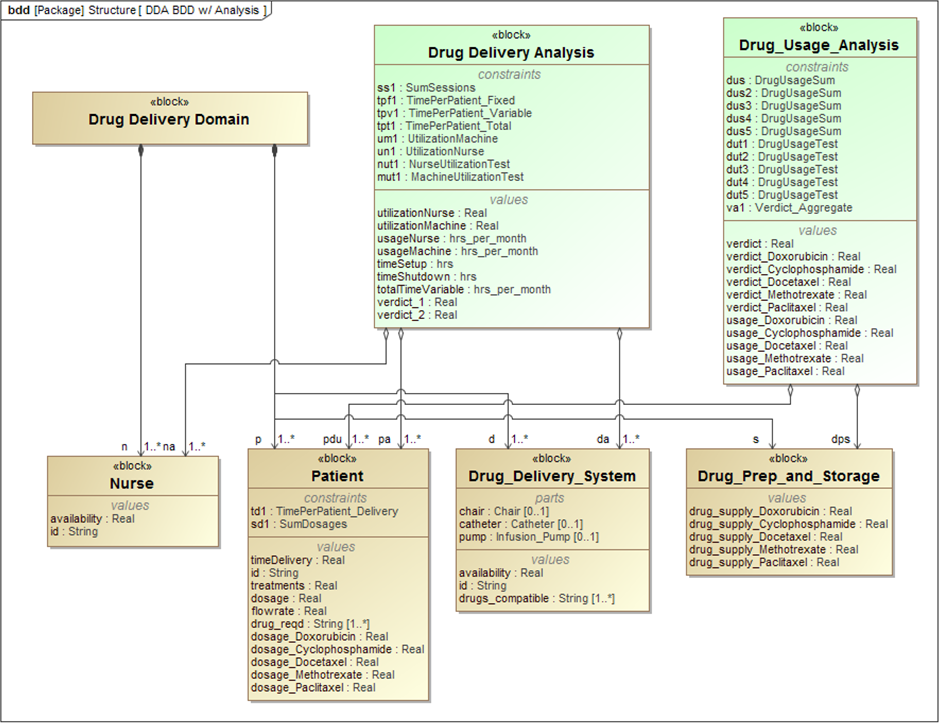 Drug Delivery Facility Structure – SysML Block Definition Diagram
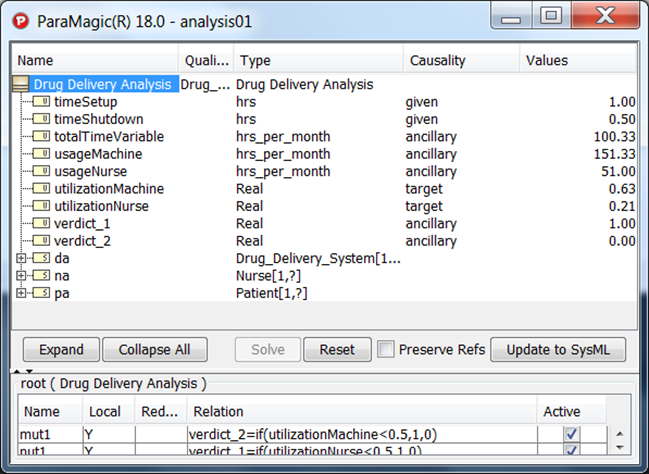 Instance01 – Two machines
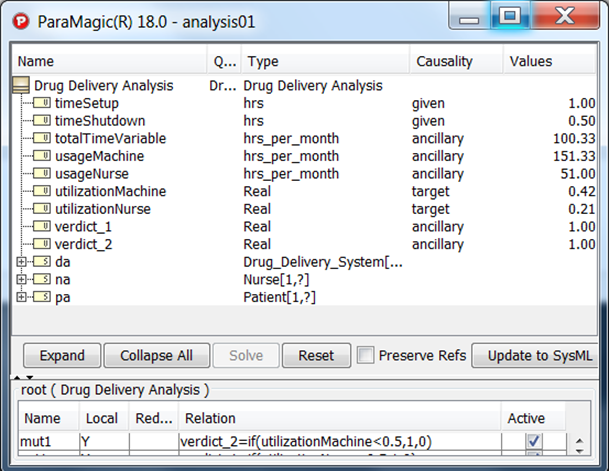 Instance02 – Three machines
Related blog posts:
- Applications of MBE for Healthcare Part 1 – A Complex System-of-Systems
- Applications of MBE for Healthcare: Part 2 – Simulating the Cardiovascular System
- Applications of MBE for Healthcare: Part 3 – Verifying Healthcare Delivery Requirements (this post)
- Applications of MBE for Healthcare Part 4 – Designing Medical Devices
- Applications of MBE for Healthcare Part 5 – Managing Project Issues