
Describing Syndeia from Intercax quickly and clearly becomes more challenging with each new release. It is both an extensive set of point-to-point integrations between engineering software tools and a means for analyzing, visualizing and documenting all the connections between them, the Digital Thread. In a new video, we offer a whirlwind introduction to Syndeia as a starting point for your evaluation.

The Digital Thread consists of a set of connections, both connections inside each domain model (intra-model) and the connections between models in different repositories (inter-model) that Syndeia manages. The inter-model connections can be anything from persistent traceable links to full model transforms that share artifacts, attributes and relationships between models with compare and update capabilities. Syndeia supports multiple use cases because organizations support multiple approaches to Digital Transformation.
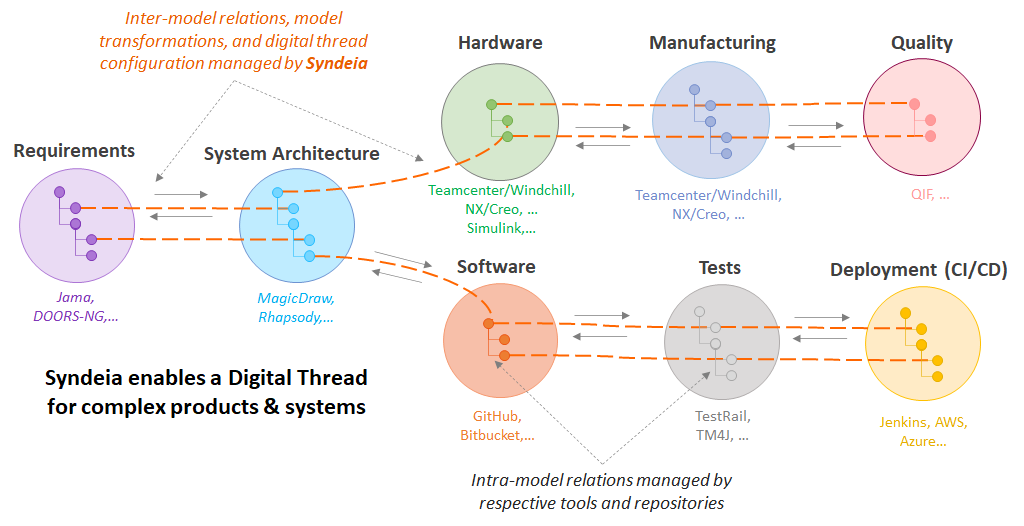
syndeia-digital-thread-mbse-software

Figure 1 One view of the Digital Thread

How does Syndeia do this? It has a server-based component called Syndeia Cloud resident in either a customer on-premises server or a private cloud, and a series of local clients, including user-written clients, that access it through an open REST API.
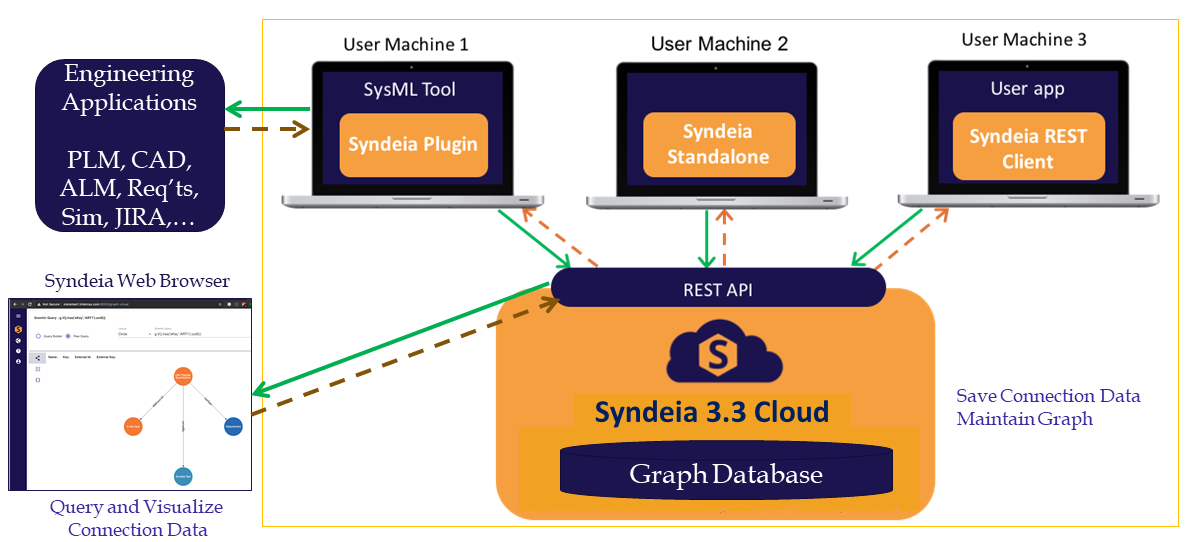
syndeia-architecture-new

Figure 2 Syndeia 3.3 Architecture

In the latest release, Syndeia 3.3, the web browser portal offers powerful graph analysis capability to visualize the Digital Thread. Using pattern-matching queries, users can ask questions such as, “Show all the requirements tied to test cases via the architecture model and code repository”. Scalable databases and rapid search algorithms can deliver answers quickly even for system with millions of model elements.
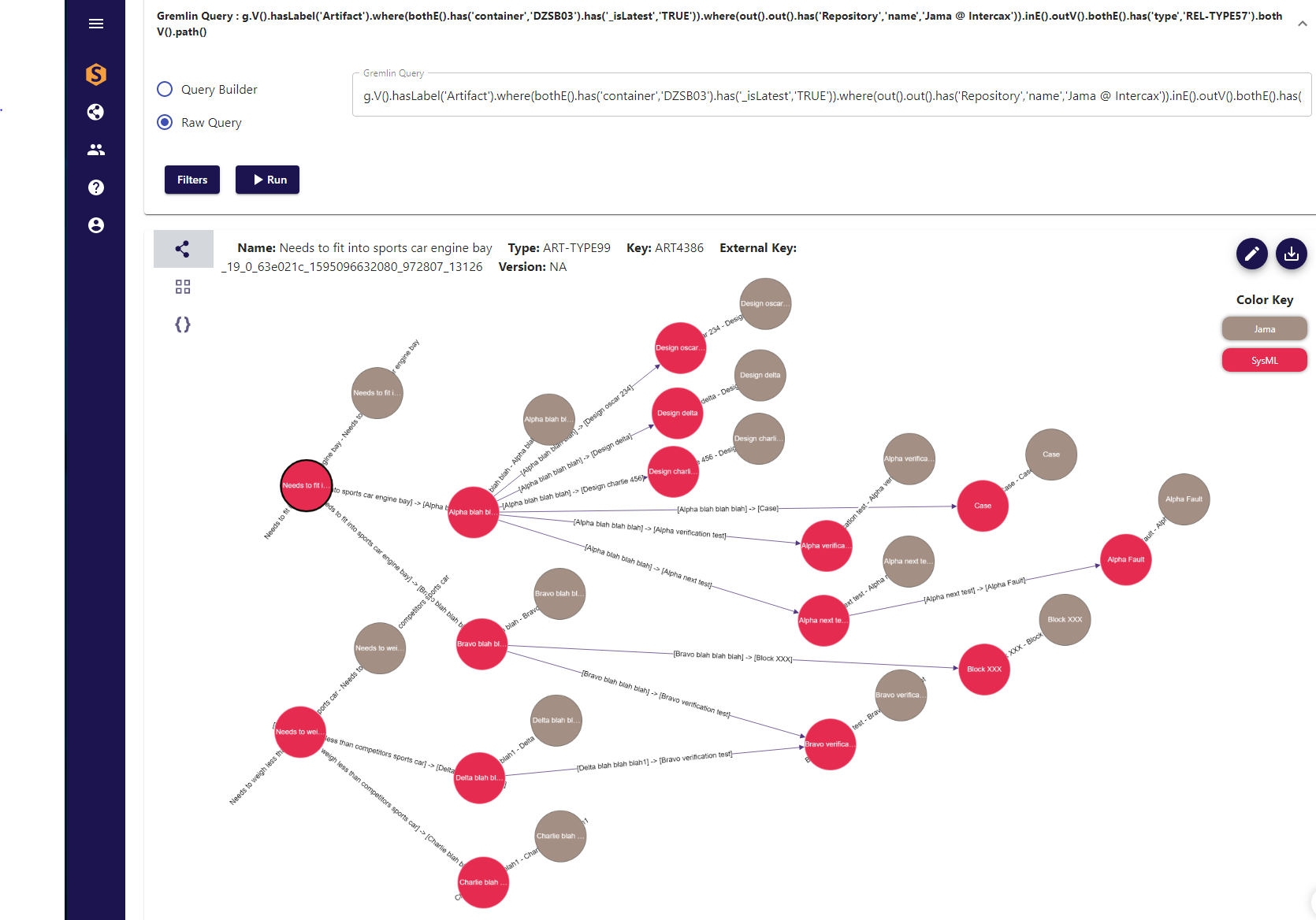
Figure 3 Syndeia 3.3 graph analysis via the web portal

Explore the possibilities by contacting us at info@intercax.com and learn what Syndeia might do for you.

Tags:
Blog

Related Posts

Pipelines Part 3 – Matching Requirements to Parts using Syndeia Digital Pipelines

We’re continuing our blog series on using Syndeia digital pipelines to execute real world use cases in systems engineering. In Part 2, we demonstrated a digital pipeline that ...
Dirk Zwemer and Gregory Seeds

Pipelines Part 2 – Gap Analysis between Requirements and Tests

Demonstrating measurable ROI from digital engineering is just as important in driving enterprise adoption as customer mandates, e.g. DoDI 5000.97. In particular, the concept of ...
Dirk Zwemer and Gregory Seeds

Pipelines Part 1: Quick Introduction and Demo

Syndeia Pipelines automate digital engineering workflows by orchestrating complex, multi-step tasks, such as ETL operations, cross-repository queries, model transformations/syncs, ...
Manas Bajaj

Christmas at the North Pole, Powered by Pipelines🎄

While the rest of the world is busy hanging lights, doing last minute gift shopping, and sipping cocoa, the North Pole is deep in digital engineering mode. Snow is falling, elves ...
Manas Bajaj

What’s New in Syndeia 3.7? - Part 1

We are excited to release Syndeia 3.7, the next generation of our digital thread platform for integrated digital engineering. Check out the latest features in less than 5 minutes ...
Dirk Zwemer

Model-Based Systems Engineering for Autonomous Vehicles, Part 16 – Custom Dashboards

In Parts 1-10 of this blog series, we built a digital thread for an autonomous vehicle system to demonstrate how a federation of models in different software tools can become a ...
Dirk Zwemer

Model-Based Systems Engineering for Autonomous Vehicles, Part 15 – Digital Pipelines

In Part 14 of this series, we developed a custom script to calculate project metrics for our Autonomous Vehicle digital thread project. The value of this information is greatest ...
Dirk Zwemer

Model-Based Systems Engineering for Autonomous Vehicles, Part 14 – Open REST API

Syndeia has been developed as an API-first enterprise application, i.e. the full capabilities of the software are exposed through an open REST API with the understanding that the ...
Dirk Zwemer

Model-Based Systems Engineering for Autonomous Vehicles, Part 13 – Digital Reports

A key function of Digital Threads is to be able to answer questions about project status in real-time without the overhead of data collection, status reports and meetings. In this ...
Dirk Zwemer