
The value of building a Digital Thread goes well beyond the point-to-point integrations from which it is built. It lies in the ability of all project members to find and access the information they need in any tool, database or repository where it resides. This capability must accommodate real development projects with millions of model elements.
digital-thread-syndeia-mbse-1

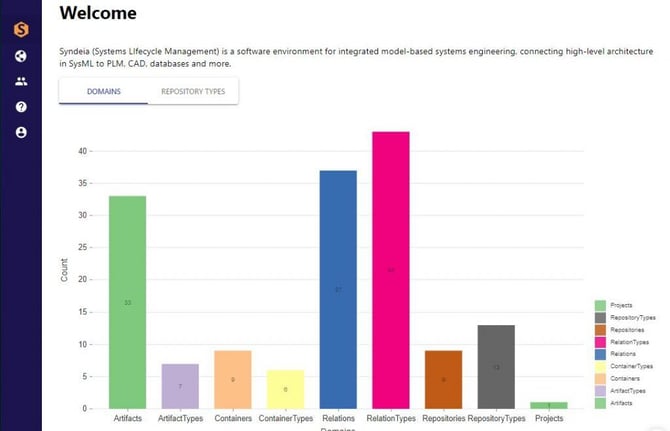
Figure 1 Digital Thread metrics in Syndeia web brow

Syndeia, the MBSE interoperability platform from Intercax, introduces a web browser interface for graphical queries in its upcoming 3.3 release. As before, Syndeia allows users to create connections between model elements in PLM, SysML, CAD, simulation, requirements, and other domains through a variety of plug-in and stand-alone clients. Syndeia 3.3 expands capabilities in all these areas, but for the first time, it also provides a web browser to access the server-based Syndeia Cloud connection database so that the Digital Thread being created can be accessed by any credentialed user. Figure 1 shows the opening view with a columnar display of project metrics: number of artifacts, relationships, and other modeling elements in the graph.
query-builder

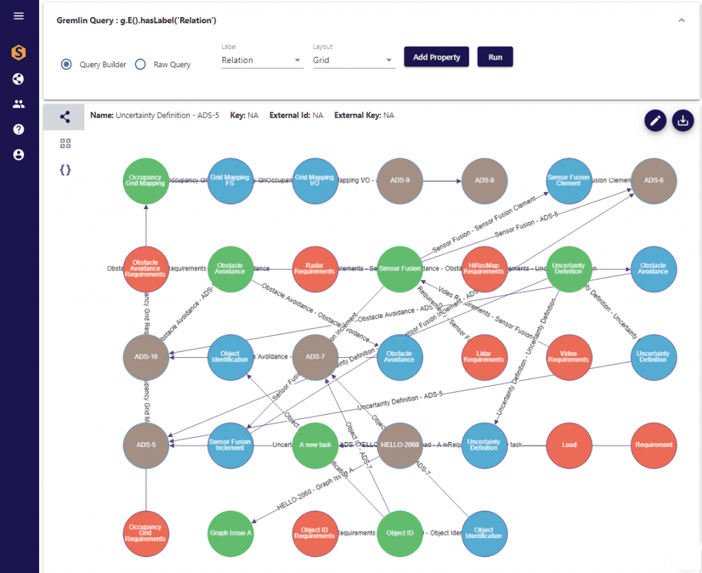
Figure 2 Query Builder, Display all relations between artifacts

Specific queries can be made using either the Query Builder or Raw Query modes. Figure 2 shows a query to display all model relations, entered in Query Builder mode. The display shows forty-three relations (edges) between model artifacts (nodes) in the results, color-coded by domain: red for DOORS NG, green for GitHub, blue for TestRail and gray for JIRA. Right-clicking on any icon opens access to the element itself, assuming the user has access to the repository where it lives. The same results can also be displayed in tabular or JSON output and exported in appropriate forms.
raw-query

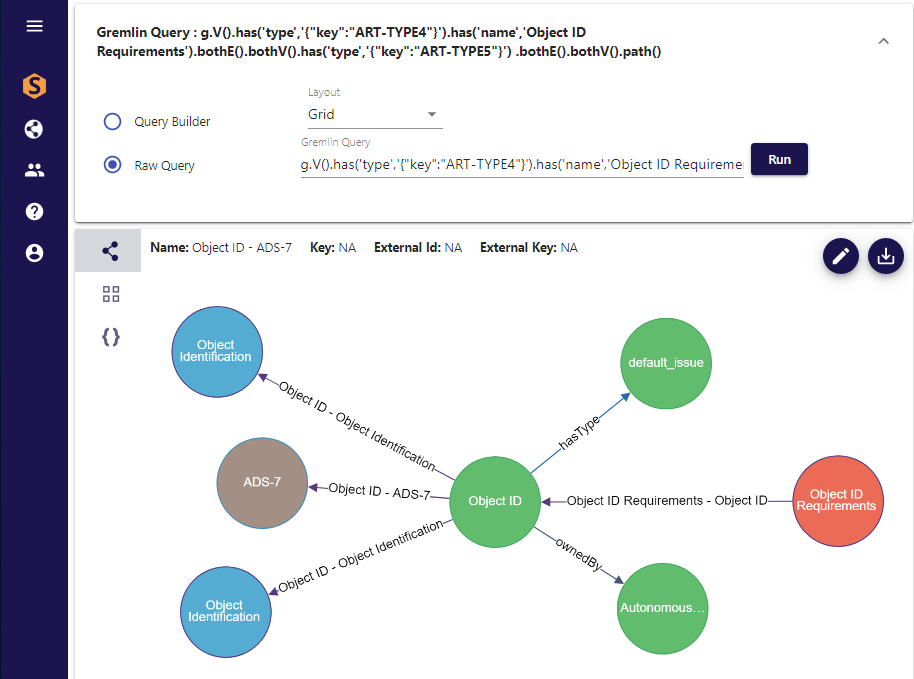
Figure 3 Raw Query, display nodes and edges connected to DOORS NG element, “Object ID Requirements”

More specific queries can be entered directly in the Raw Query mode, using the Gremlin graph query language. Figure 3 is an example of a search for a specific pattern: find a DOORS NG requirement specification named “Object ID Requirements”, find all GitHub issues connected to it and find all other model elements connected to the GitHub issues. The results display the DOORS NG element connected through one or more links to GitHub, JIRA and TestRail elements. The value of such queries is that they can identify the potential impact of a change in one element, for example, a DOORS NG requirement, on elements in other domains.

A new video is available offering a more complete demonstration of the Syndeia web browser and graph query capability -

Check out our website or contact us at info@intercax.com to learn more.

Tags:
Blog

Related Posts

Pipelines Part 3 – Matching Requirements to Parts using Syndeia Digital Pipelines

We’re continuing our blog series on using Syndeia digital pipelines to execute real world use cases in systems engineering. In Part 2, we demonstrated a digital pipeline that ...
Dirk Zwemer and Gregory Seeds

Pipelines Part 2 – Gap Analysis between Requirements and Tests

Demonstrating measurable ROI from digital engineering is just as important in driving enterprise adoption as customer mandates, e.g. DoDI 5000.97. In particular, the concept of ...
Dirk Zwemer and Gregory Seeds

Pipelines Part 1: Quick Introduction and Demo

Syndeia Pipelines automate digital engineering workflows by orchestrating complex, multi-step tasks, such as ETL operations, cross-repository queries, model transformations/syncs, ...
Manas Bajaj

Christmas at the North Pole, Powered by Pipelines🎄

While the rest of the world is busy hanging lights, doing last minute gift shopping, and sipping cocoa, the North Pole is deep in digital engineering mode. Snow is falling, elves ...
Manas Bajaj

What’s New in Syndeia 3.7? - Part 1

We are excited to release Syndeia 3.7, the next generation of our digital thread platform for integrated digital engineering. Check out the latest features in less than 5 minutes ...
Dirk Zwemer

Model-Based Systems Engineering for Autonomous Vehicles, Part 16 – Custom Dashboards

In Parts 1-10 of this blog series, we built a digital thread for an autonomous vehicle system to demonstrate how a federation of models in different software tools can become a ...
Dirk Zwemer

Model-Based Systems Engineering for Autonomous Vehicles, Part 15 – Digital Pipelines

In Part 14 of this series, we developed a custom script to calculate project metrics for our Autonomous Vehicle digital thread project. The value of this information is greatest ...
Dirk Zwemer

Model-Based Systems Engineering for Autonomous Vehicles, Part 14 – Open REST API

Syndeia has been developed as an API-first enterprise application, i.e. the full capabilities of the software are exposed through an open REST API with the understanding that the ...
Dirk Zwemer

Model-Based Systems Engineering for Autonomous Vehicles, Part 13 – Digital Reports

A key function of Digital Threads is to be able to answer questions about project status in real-time without the overhead of data collection, status reports and meetings. In this ...
Dirk Zwemer