
Introduction

The apocalypse is approaching rapidly, according to a wide variety of media outlets. It is therefore the first responsibility of the systems engineering community to model it correctly. In a technical note published entirely coincidentally on April Fool’s Day, we contribute to that important work. Links to the technical note and downloadable SysML models are available at the end of the post.

Modeling How The World Ends

In Figure 1, we model potentially world-ending threats in terms of three factors, the source or origin of the threat, the nature of the threat, and the target of the threat.
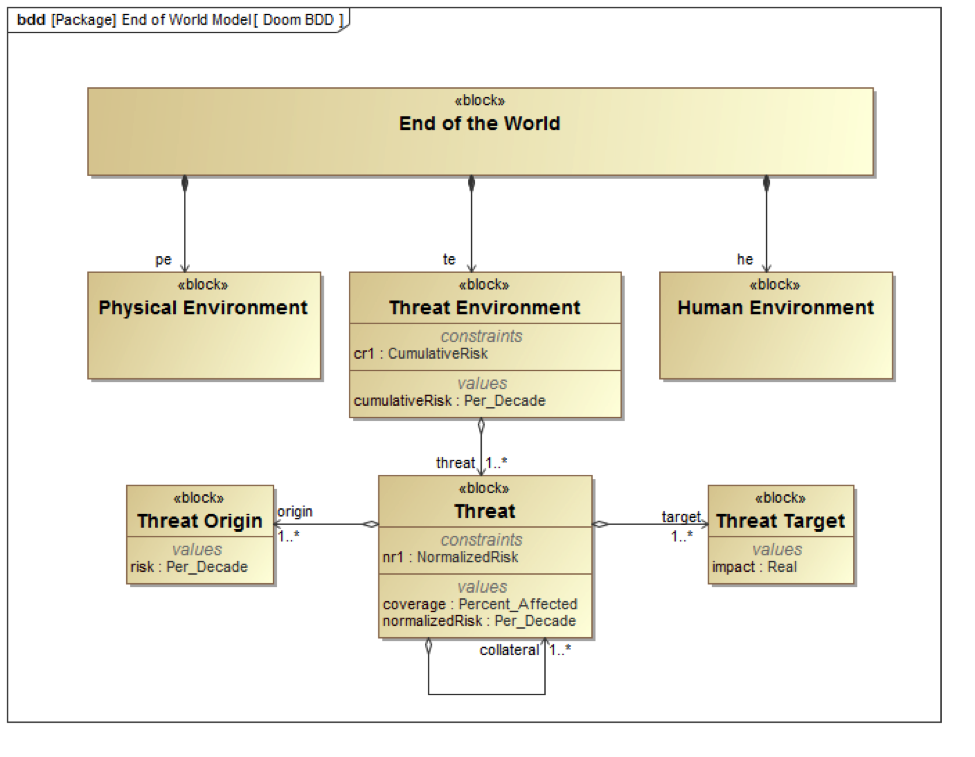
Basic structure of the End of the World - How The World Ends

Figure 1 Basic structure of the End of the World

In Figure 2, we show a variety of threats, ranging from Asteroid Strike to Singularity, the subordination of humanity to artificial intelligence.
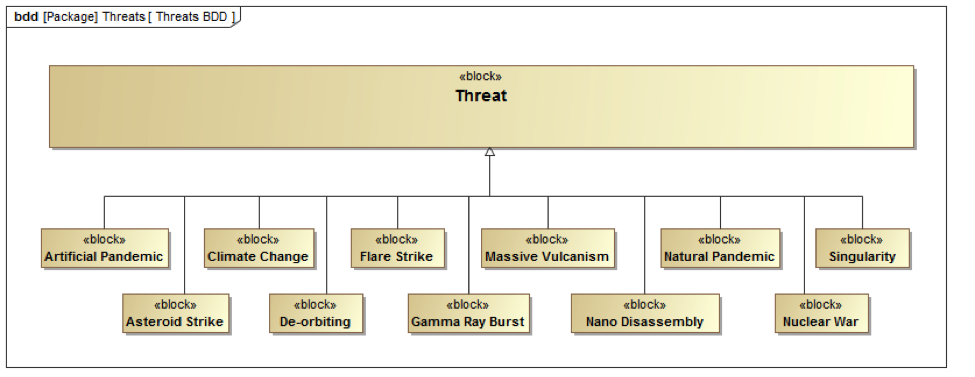
threats to the end of the world - How The World Ends

Figure 2 Threats

Having specified the possible threats, MBSE also provides means to quantify them. The SysML model created includes parametric diagrams where we calculate the normalized risk of a threat, the product of its risk of occurrence, coverage of population and impact. The model recognizes that threats are not uncorrelated, for example, even a limited nuclear war may give rise to climate change through global cooling. Figure 3 shows a solved instance for this scenario, with the comforting result that total cumulative risk per decade is no greater than 2.6%.
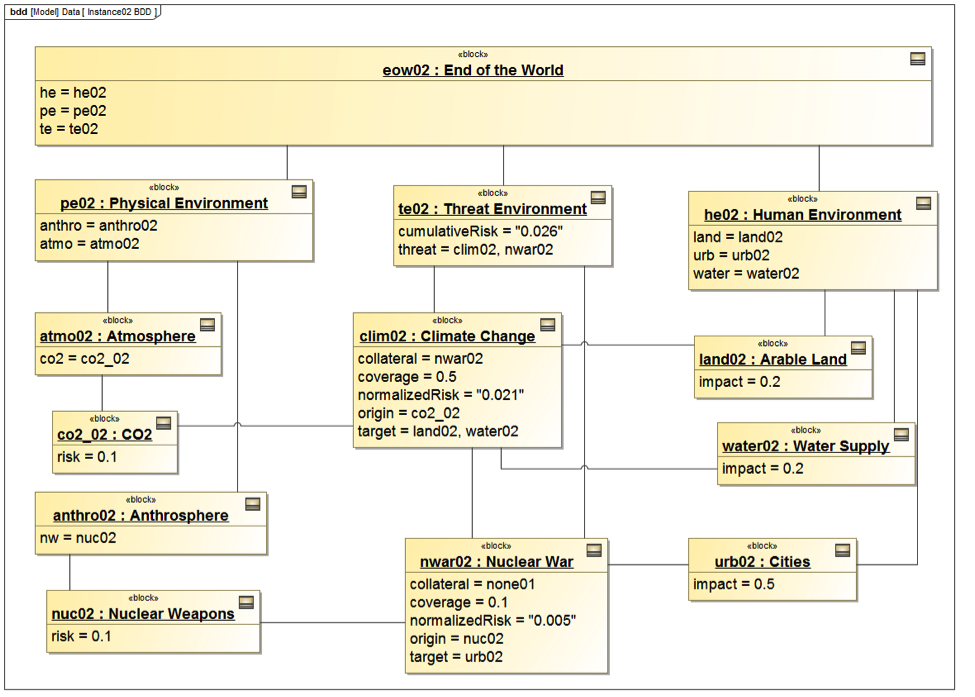
Cumulative risk of nuclear war and climate change end of the world - How The World Ends

Figure 3 SysML parametric analysis, cumulative risk of limited nuclear war and climate change

Technote: How the World Ends

Tags:
Blog

Related Posts

Christmas at the North Pole, Powered by Pipelines🎄

While the rest of the world is busy hanging lights, doing last minute gift shopping, and sipping cocoa, the North Pole is deep in digital engineering mode. Snow is falling, elves ...
Manas Bajaj

What’s New in Syndeia 3.7? - Part 1

We are excited to release Syndeia 3.7, the next generation of our digital thread platform for integrated digital engineering. Check out the latest features in less than 5 minutes ...
Dirk Zwemer

Model-Based Systems Engineering for Autonomous Vehicles, Part 16 – Custom Dashboards

In Parts 1-10 of this blog series, we built a digital thread for an autonomous vehicle system to demonstrate how a federation of models in different software tools can become a ...
Dirk Zwemer

Model-Based Systems Engineering for Autonomous Vehicles, Part 15 – Digital Pipelines

In Part 14 of this series, we developed a custom script to calculate project metrics for our Autonomous Vehicle digital thread project. The value of this information is greatest ...
Dirk Zwemer

Model-Based Systems Engineering for Autonomous Vehicles, Part 14 – Open REST API

Syndeia has been developed as an API-first enterprise application, i.e. the full capabilities of the software are exposed through an open REST API with the understanding that the ...
Dirk Zwemer

Model-Based Systems Engineering for Autonomous Vehicles, Part 13 – Digital Reports

A key function of Digital Threads is to be able to answer questions about project status in real-time without the overhead of data collection, status reports and meetings. In this ...
Dirk Zwemer

Model-Based Systems Engineering for Autonomous Vehicles, Part 12 – Digital Projects

In this post, we continue our updating of MBSE for autonomous vehicles in light of the current and upcoming capabilities of Syndeia, the digital thread platform from Intercax. As ...
Dirk Zwemer

Model-Based Systems Engineering for Autonomous Vehicles, Part 11 – Digital Threads

In 2018, I published a ten-part blog series applying MBSE to an autonomous vehicle. That series continues to garner views on our website, but the state-of-the-art has advanced ...
Dirk Zwemer

Syndeia AI Multiple Agents, Part 4

Hello and welcome to a new demonstration of Syndeia AI that shows multiple AI agents in action – SysML v2, Teamcenter, Windchill, Jira, Jama Connect, Teamwork Cloud, and a Digital ...
Manas Bajaj